
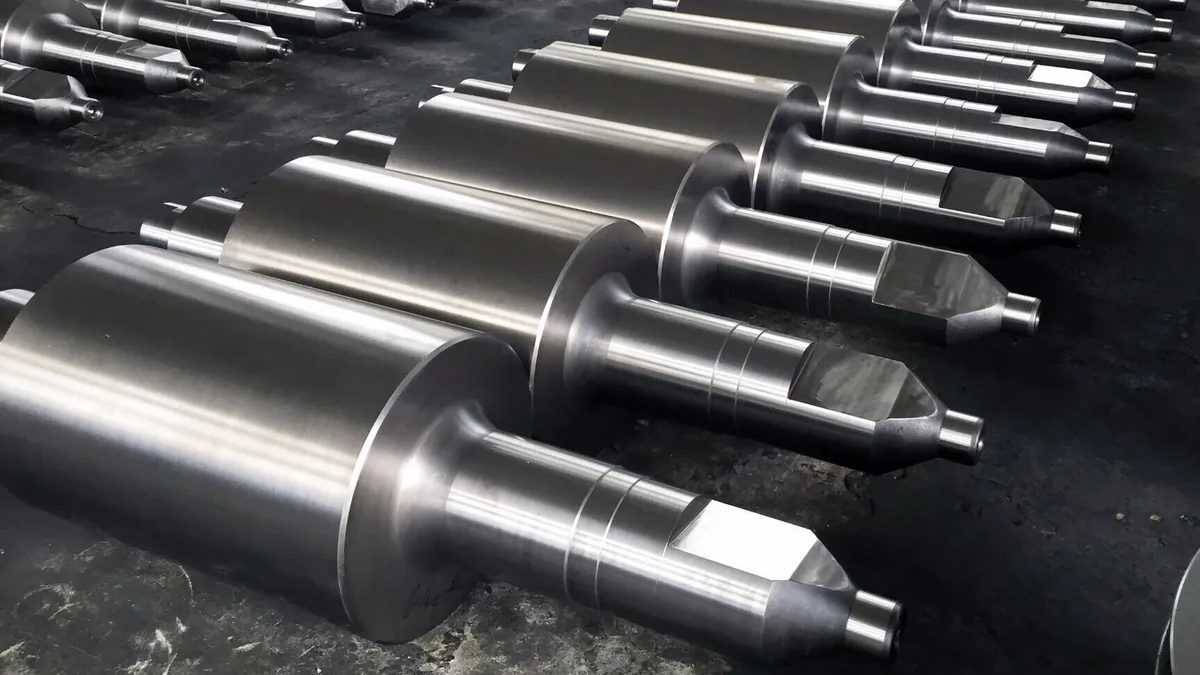
Roll life, the service life of a roll, is the tonnage a roll rolls before it is scrapped: tonnes per groove in each campaign, across every groove on the barrel, over every redress from new diameter to scrap diameter. Five things decide it, and they are also the five ways to increase roll life: the grade matched to the stand, cooling, the load each pass carries, how much is machined off at each redress, and how the roll is handled between campaigns.
This guide is written for bar, wire rod and TMT mills. It explains how to measure roll life, where it is lost, the warning signs on a used roll and what to ask your roll maker before you order.
Key takeaways
- Measure roll life in tonnes, not in days or campaigns. Tonnes per groove, tonnes per millimetre of diameter removed and tonnes per roll show where the life goes.
- The usable diameter is the budget. Every millimetre turned off that does not remove damage is life thrown away.
- A grade that suits the stand matters more than a harder grade. Hard rolls wear slowly but take shock badly.
- Steady cooling water on the running roll prevents most fire cracks. Water on a stopped roll causes them.
- Read the used roll. Fire cracks, spalling, uneven groove wear and pitting each point to a different cause.
How roll life is measured
In bar, rod and TMT mills a roll carries several grooves along its barrel. The mill rolls on one groove until it wears out of size, then moves to the next. When every groove is worn, the roll comes out, is machined to remove the wear and any cracks, and the grooves are cut again at a smaller diameter. That cycle repeats until the roll reaches its scrap diameter.
So the life of one roll is the product of three numbers:
Roll life (tonnes) = tonnes per groove × grooves per barrel × number of redresses
Each number has its own lever. Tonnes per groove depends on grade, cooling and pass load. Grooves per barrel is set by the barrel length and pass design. The number of redresses depends on the usable diameter and how much is taken off each time.
Track four figures in a simple roll record, one line per roll:
- Tonnes per groove for each campaign, by stand. This shows whether a grade or a cooling change worked.
- Diameter removed at each redress, in millimetres. This shows whether the machine shop is taking off more than the damage.
- Tonnes per millimetre of diameter, total tonnes divided by total diameter removed. This is the fairest way to compare two grades or two suppliers on the same stand.
- Roll cost per tonne rolled, the roll price divided by its lifetime tonnes. A cheaper roll that rolls fewer tonnes is often the dearer roll. Some mills track the same thing as roll consumption, in kilograms of roll per tonne of steel rolled.
Without these figures, a mill can only say a roll "did not last". With them, it can say which of the three numbers fell, and why.

The working layer sets the limit
A roll can only be turned down as far as its scrap diameter, and that is fixed by the working layer. Double-poured rolls carry a hard shell around a softer core; on a single-cast or steel roll the structure and hardness change more gradually towards the centre.
For each grade, a hardness-depth chart shows how the roll will behave in its later campaigns. Where the line stays flat, the roll gives as many tonnes per groove late in its life as when new. Where it falls, each redress brings the groove closer to softer material, and tonnes per groove drop.
Two rules follow. Ask for the new diameter and the scrap diameter before you order, because the difference between them is the budget you are buying. And plan redresses so the groove bottom never reaches the zone where the chart steps down.
Matching the roll to the stand
The single biggest lever on roll life is the grade. Each stand group asks something different of the roll. Roughing stands take the biggest reductions, the hottest stock and the heaviest shock, so they need toughness. Finishing stands must keep each groove in size for a long campaign, so they need wear resistance.
A harder grade in the wrong stand does not last longer. It cracks or breaks. A tougher grade in a finishing stand wears out of size early. The table gives the stand groups each Vimco Rolls grade is listed for.
| Stand group | What the roll needs | Grades listed for it (Vimco Rolls) |
|---|---|---|
| Roughing | Toughness against shock and heat | Adamite; forged rolls in bar mills; SG iron pearlitic; in heavier section mills, alloy cast steel |
| Intermediate | A balance of toughness and wear resistance | ICDP; indefinite chilled; SG iron acicular; SG iron pearlitic |
| Finishing | Wear resistance to hold the groove to size | HSS; ICDP; indefinite chilled; SG iron acicular |
| Finishing block (wire rod) | Extreme wear resistance at the highest speed | Tungsten carbide rings |
| Section mills that suffer fire cracks | Resistance to fire cracks | Graphitic steel |
The full stand-by-stand picture, with the stock temperature at each stage, is in Steel Rolling Process Explained. For finishing stands, the choice between the two main grades is covered in HSS vs ICDP rolls. Vimco Rolls estimates the useful life of its HSS rolls at 5 to 6 times that of conventional rolls, which is why the comparison is made on cost per tonne and not on price per roll.
Cooling water
In a hot mill the roll surface is heated by the stock in the roll bite and cooled by water as it turns away. That happens on every revolution. The aim of cooling is to keep that cycle steady and shallow, so the surface never runs hot enough to soften, and the thermal stress stays below the level that starts thermal fatigue cracks.
Three habits protect roll life:
- Keep water on the roll the whole time it is rolling. A blocked nozzle or a drop in flow lets one band of the barrel run hot, and the cracks start there.
- Aim the water where the roll leaves the stock, along the full length of the groove in use, and check nozzles at every roll change. Dirty water blocks nozzles; check the filters too.
- Never put water on a hot roll that has stopped. A standing roll under a jet cools in one strip instead of evenly round its circumference. That is the thermal shock behind fire cracks and, in the worst case, a broken roll.
Pass load and groove wear
Each groove wears in proportion to the work it does. If the reduction is not spread sensibly across the stands, the overloaded stands wear their grooves out of size first, and the whole set changes early because of one or two stands.
Wear inside a groove is often uneven too. Some parts of the profile do more work than others, and a misaligned guide wears one flank. Look at the worn groove before it is machined: the shape of the wear tells you whether the problem is load, guiding or cooling.
Change grooves on wear, measured, not on a fixed tonnage habit. A groove taken off too early wastes tonnes. A groove run too long needs more diameter removed to restore it, and that costs redresses.
Scale matters here too. Scale left on the billet is pressed into the groove surface and pits it. A pitted groove also marks the bar, so surface quality suffers along with roll life. Good descaling before the roughing stands protects every groove downstream.
Redressing: remove only the damage
Every redress is a withdrawal from the diameter budget. The aim is to remove the worn profile and every crack, and nothing more.
Take off too little, and fine cracks are left under the new groove. They grow in the next campaign, and the roll fails prematurely through spalling or roll breakage. Take off too much, and sound material goes to the swarf, which shortens the roll's life by whole campaigns over its working diameter.
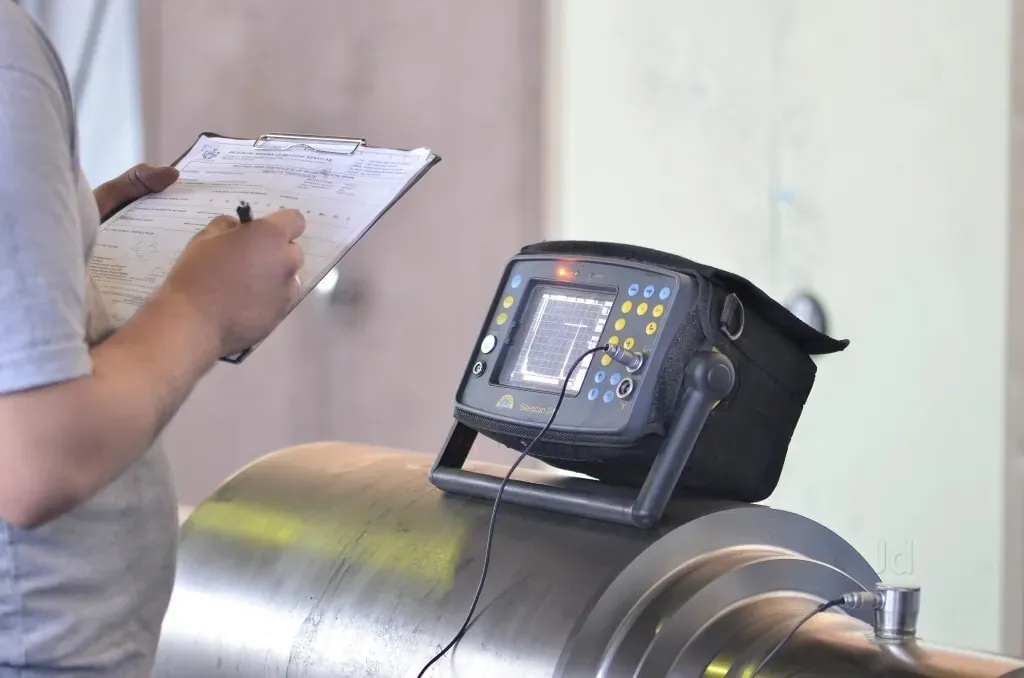
The way to hit the right amount is to check, not guess. Inspect the surface for cracks after the first cut and before the final profile, with a crack detection method that suits the roll, such as dye penetrant, magnetic particle, eddy current or ultrasonic testing. Record the diameter removed each time. If one machine shop crew or one stand always takes more off, the roll record will show it.
Handling, storage and the roll change
Many rolls are damaged off the mill. A few habits stop it:
- Lift by the necks with proper slings, never by the barrel, and never let a roll swing into another.
- Store rolls dry, on padded supports, with the barrel and necks protected against rust and knocks.
- Check neck and bearing seats, chocks, bearings and stand and guide alignment at each roll change. A roll seated badly runs off-centre and loads one end of the barrel.
- Ask your roll maker whether the grade needs a gradual start before full load. A cold roll put straight into heavy rolling takes a thermal shock it does not need.
- After a cobble, inspect the roll before it goes back in. A cobble can leave cracks or a damaged groove that fail in the next campaign.
Warning signs on a used roll
A used roll is a report on how it was run. Read it before it goes to the machine shop.
| What you see | What it usually points to | Where to look first |
|---|---|---|
| Fine network of cracks on the groove surface (fire cracks) | Thermal fatigue from repeated heating and cooling | Cooling water flow, blocked nozzles, water on a stopped roll, a grade without fire crack resistance |
| Pieces of the surface breaking away (spalling) | Cracks that grew under rolling load, often left behind after a redress | Diameter removed at the last redress, crack checks, overload on that stand |
| Broken roll or broken neck | Overload, a cobble, thermal shock, or a grade too hard for the stand | Mill events in the last campaign, cooling after stops, the grade on that stand |
| Groove worn out of size early, or worn on one side | Too much reduction on that stand, or a misaligned guide | Pass schedule, guide setting, groove change practice |
| Pitted or rough groove surface | Scale pressed into the groove, or the groove run too hot | Descaling, cooling on that stand |
Keep a photo of each failed or badly worn roll with its roll record. When you speak to your roll maker, the photo and the tonnes it rolled say more than any description.
What to ask your roll maker
Roll life starts before the roll reaches the mill. Ask for these before you place the order:
- The grade recommended for your stand, and why, given your mill, the stand position and the steel you roll.
- The hardness range and the hardness-depth chart for that grade, not only the surface value.
- New diameter and scrap diameter, so you know the diameter budget you are paying for.
- The chemical analysis of the roll as cast, from the maker's own laboratory.
- The ultrasonic test record for the roll, showing it was checked for internal defects before dispatch.
- Advice on cooling and redressing for the grade: whether it needs a gradual start, and how to remove cracks without wasting diameter.
When the rolls arrive, carry out an acceptance inspection against these documents: dimensions, hardness and test records, before the rolls go into stock.
The equipment behind these checks at Vimco Rolls is listed on the quality page: portable and laboratory hardness testers, an ultrasonic testing machine, a metallurgical microscope, an optical emission spectrometer and a complete wet chemical laboratory.
Frequently asked questions
How is roll life defined?
Roll life is the total tonnage a rolling mill roll rolls from new diameter to scrap diameter. In long-product mills it is tonnes per groove, multiplied by the grooves on the barrel, multiplied by the number of redresses the working layer allows.
Will a harder grade give more tonnes?
Not always. A harder roll wears more slowly but takes shock less well. In roughing stands a hard roll is more likely to crack or break, which ends its life far sooner than wear would. The right grade is the one that suits the stand, as explained in Roll Hardness Explained.
How much should be removed at each redress?
Enough to remove the worn profile and every crack, and no more. The amount depends on the grade, the stand and how long the groove was run, so it should be decided by crack checks during machining, not by a fixed figure. Record it each time to see the trend.
Can cooling water shorten roll life?
Yes, when it is applied badly. Uneven or interrupted cooling on a running roll lets parts of the barrel run hot, and water on a stopped hot roll causes thermal shock. Both lead to fire cracks. Steady water on the running roll is what extends life.
Is pass life the same as roll life?
No. Pass life is how many tonnes one groove carries until it wears out of size. Roll life is the total for the whole roll, across all its grooves and redresses. A grade can improve pass life and still give a poor roll life if its hard layer is shallow.
Rolls wearing out too fast?
Vimco Rolls Pvt Ltd, Dera Bassi, Punjab, has been making rolls since 1972. Send your mill, the stand, the steel you roll and a photo of the used roll, and our team will suggest a grade.
Tell us your mill and standDiscuss this for your mill
Share your stand details and we will suggest the roll grade for it.