
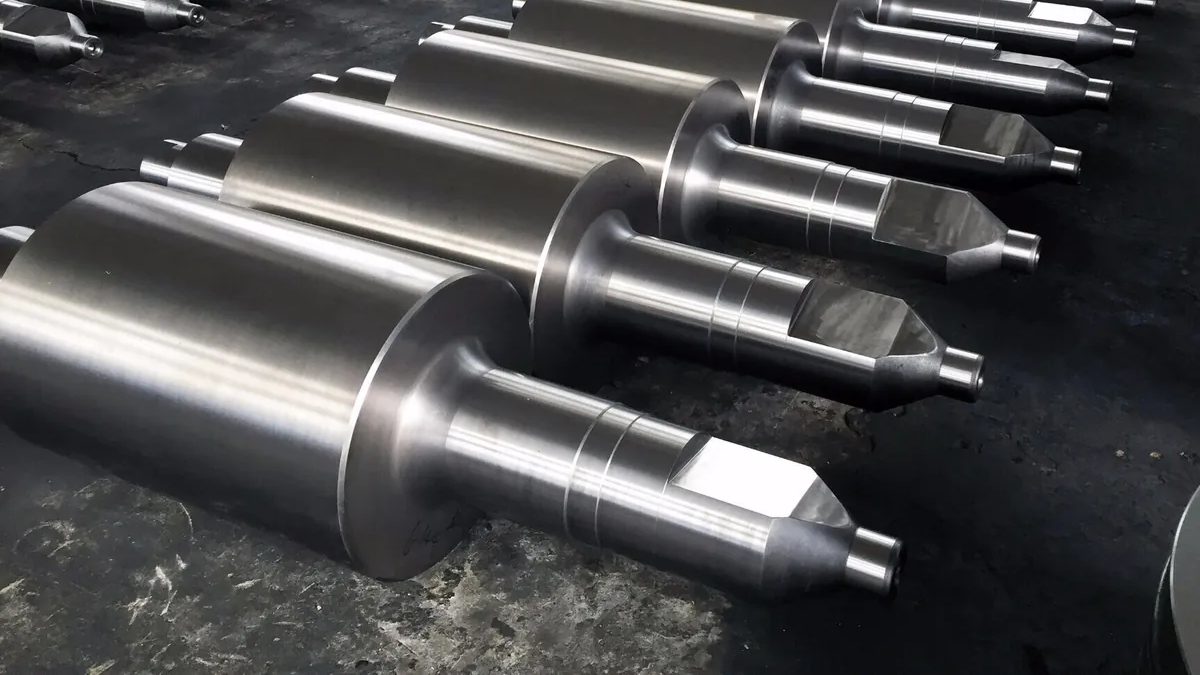
A finishing mill is the set of stands at the end of a hot rolling line, after the intermediate group. Whatever size, tolerance and surface the product leaves with are decided here. Reductions are lighter and speeds are the highest in the line, so finishing mill rolls are chosen mainly for how long a groove holds its shape.
This guide lists the roll grades used on each type of finishing stand in TMT bar, rebar, wire rod, structural and strip mills, and shows how to narrow the choice for your own stand. Grades and hardness figures are the ones published on our product pages.
Key takeaways
- A finishing groove that goes out of size puts the product out of tolerance, and nothing after the last stand can correct it. Wear resistance therefore leads the choice of grade.
- Four grades are listed for TMT bar and wire rod finishing stands: HSS, SG iron acicular, ICDP and indefinite chilled.
- Two positions have their own answer. Slitting and dog-bone stands of rebar mills use HSS, and the finishing block of a wire rod mill uses TC rings.
- Finishing grades run from 50 Shore C (SG iron pearlitic, on structural and strip mills) to 85 Shore C (HSS).
- Check hardness below the surface as well. On our published charts HSS stays nearly level across 75 mm, while ICDP falls away near 40 to 50 mm, at the boundary between shell and core.
What a finishing mill does
By the time stock reaches the finishing group, the roughing stands and the intermediate stands have done most of the reduction. The billet that entered the line is now a much smaller section, at a lower temperature than it had in the roughing stands. The finishing mill takes a smaller bite at each stand and brings that section to its exact shape and size. Our steel rolling process guide shows where this group sits in the line.
Steel keeps its volume through the stands, so a smaller section has to travel faster. That makes the finishing stands the fastest part of the mill.
On a continuous line one bar runs through several stands at the same moment, so each stand's speed has to match its neighbours. A mismatch either stretches the stock or lets a loop form between stands, and both show up as size variation on the product. Operators can adjust the roll gap to correct a small size error, but a groove that has lost its shape has to be changed.
On a TMT bar, the finishing rolls give the size, rib shape and surface. The quench line that follows sets the strength of the bar but cannot repair its dimensions. Wire rod is laid into loops and cooled under control before it becomes a coil, and it too keeps the dimensions the last groove gave it.
Why finishing rolls are chosen for wear resistance
Four things about this stand group push the choice of roll toward wear resistance.
- Tolerance. Groove wear shows directly on the product. Once the bar drifts out of size, the pass has to be changed even if the roll itself is sound.
- Surface. The product takes its surface from the groove. A groove that roughens in service passes that surface on to every metre rolled after it.
- Metal per hour. Stock moves fastest through these stands, so each groove passes more metal in an hour than a groove earlier in the line, and its wear builds up quickly.
- Pass changes. Every change of a worn pass costs production time and energy. A longer pass life means less roll changing time, more hours of rolling and lower roll consumption per tonne.
Toughness still counts on these stands, because higher hardness also raises the risk of a roll failing in service. Our roll hardness guide explains how to read that trade-off in Shore C numbers.
Roll grades listed for each finishing stand
The table sets out each type of finishing stand against the grades we list for it. Open any grade for its composition and full specification.
| Stand | Mills | Vimco Rolls grades | Hardness |
|---|---|---|---|
| Finishing stands | TMT bar, wire rod | HSS; SG iron acicular (SGA-62, SGA-67, SGA-72); ICDP (IC-III, IC-IV, IC-V); indefinite chilled (ICCI-I, ICCI-II, ICCI-III, Bainitic Chill) | 80 to 85; 60 to 75; about 70 to 85 at the shell, from the chart; 55 to 75 Shore C |
| Slitting and dog-bone stands | Rebar | HSS | 80 to 85 Shore C |
| Finishing block | Wire rod, bar | TC rings | 78 to 88 HRA |
| Finishing stands | Structural | SG iron acicular; SG iron pearlitic (SGP-52, SGP-57, SGP-62); ICDP; indefinite chilled; adamite, which runs in all stands of section and structural mills | 60 to 75; 50 to 65; as above; 55 to 75; 40 to 55 Shore C |
| Finishing stands | Rail | SG iron acicular | 60 to 75 Shore C |
| Finishing stands | Strip | SG iron acicular; SG iron pearlitic; ICDP; indefinite chilled | 60 to 75; 50 to 65; as above; 55 to 75 Shore C |
| Finishing stands | Sheet, flat | ICDP; indefinite chilled | As above; 55 to 75 Shore C |
The chart puts the Shore C grades on one scale. The bands overlap heavily, which is why hardness alone rarely settles the choice on a finishing stand.

Choosing between the four grades on a TMT bar or wire rod stand
Each of the four grades reaches its wear life in its own way, and each places different demands on a mill.
| Grade | Why a mill runs it | What to plan for |
|---|---|---|
| HSS | Its MC, M2C and M6C carbides, set in tempered martensite, give high wear resistance and resist surface roughening. Estimated pass life is 5 to 6 times conventional rolls. | We list it for the finishing end only, so it does not carry back into the intermediate stands. Agree how the roll will be dressed between campaigns. |
| SG iron acicular | Nodular graphite and carbides in a bainitic matrix, with high hardness and deep hardness penetration. Three grades give steps from 60 to 75 Shore C, and the same family runs in intermediate stands. | It needs sufficient water cooling to reach its full life. |
| ICDP | A hard alloyed iron shell whose flake graphite helps heat flow and adds to roll life, on a softer core that gives fracture toughness. Suited to stands where surface finish and roll integrity are critical. | Set the scrap diameter so the groove bottom stays inside the hard shell. |
| Indefinite chilled | Static cast with a controlled hardness gradient. Flake graphite adds resistance to wear, spalling and fire cracking, and the roll suits products that need a superior surface finish. | Adequate water cooling is essential to its service life. |
Three questions narrow the list for a given stand:
- What ends the campaign today? If the groove goes out of size while the roll is otherwise sound, the stand needs more wear resistance: the next grade up in the same material, or a more wear-resistant material. If cracks end it, look at cooling before changing the grade.
- Can the stand give the cooling the grade asks for? SG iron acicular and indefinite chilled rolls both depend on it. Check water flow and spray coverage at that stand before you trial one.
- How much of the roll will you actually use? A hard surface over a shallow working layer gives fewer campaigns. The next section shows how far the published grades differ.
Where you are weighing two grades for the same stand, these comparisons go further:
- HSS and SG iron acicular are both options for these finishing stands, at 80 to 85 and 60 to 75 Shore C. The HSS rolls page sets them side by side.
- SG iron acicular and ICDP also share these stands. One is SG iron, the other a double poured roll with a shell and a core. The ICDP rolls page compares them.
- HSS and ICDP trade wear life against sticking and crack resistance. The HSS vs ICDP guide covers that decision in full.
Run any trial against a number you already record. Tonnes per groove on the current grade is the baseline, and our roll life guide works that figure up to total tonnes over the life of the roll.
How hardness holds below the groove
Redressing removes the worn layer and re-cuts the groove on a smaller diameter, so each later campaign runs on metal that began below the surface. The depth charts published with each grade show how different that metal can be from one finishing grade to the next.
| Grade | Near the surface | Deeper in the roll |
|---|---|---|
| HSS | About 75 to 84 Shore C | Nearly level across 75 mm |
| SG iron acicular | About 63 to 73 Shore C | Falls gradually to about 47 to 57 at 90 mm |
| ICDP | About 70 to 85 Shore C | Steps down near 40 to 50 mm, with the core at about 30 to 40 |
These are readings from published charts, so treat them as approximate. For your own roll, request the depth chart of the grade along with the new diameter and scrap diameter. For ICDP, also confirm where the scrap diameter sits against the shell depth.
Slitting and dog-bone stands in a rebar mill
Where a rebar mill slits, the dog-bone stand shapes the stock and the slitting stand then splits it into separate strands, each of which goes on to become its own bar. We list HSS for both positions. The groove profile needs close control here, because it decides the size and the rib geometry of every strand.
The finishing block in a wire rod mill
A wire rod line can end in a finishing block, a compact set of passes that runs after the finishing stands, where rolling speed and wear are at their highest. The passes here use rings in place of conventional rolls. We make TC rings for these blocks, and for the roll sleeves of high-speed finishing mills, at 78 to 88 HRA. HRA and Shore C are different scales, so these figures cannot be read against the chart above.
Structural, strip and flat mills
Structural and section mills have the widest list. SG iron acicular, SG iron pearlitic, ICDP and indefinite chilled rolls are all listed for their finishing stands, and each of those also runs in the intermediate stands of a structural mill. Adamite runs in all stands of these mills.
A hot strip mill has a different kind of finishing mill. The stands roll the bar from the roughing mill down to final strip thickness in tandem, with looper rolls between the stands to hold the tension. A descaling step ahead of the first stand clears the scale that grew during roughing. The rolls have a plain barrel in place of grooves, so their job is to hold profile and surface across the width of the strip.
For these lines we list ICDP and indefinite chilled rolls in the finishing stands of strip, sheet and flat mills, and SG iron acicular and pearlitic rolls in strip mills. The HSS vs ICDP guide has a separate section on hot strip stand positions.
Reading a worn finishing roll
The product and the groove both tell you what limited a campaign. These signs are the ones most tied to finishing duty.
| Sign on the product or roll | Probable cause | Next check |
|---|---|---|
| Bar leaves tolerance well before the planned tonnes | Groove wear ahead of plan | Tonnes per groove against your record, then a more wear-resistant grade for that stand |
| Bar surface worsens as the campaign goes on | The groove surface is roughening | Groove condition at the change, cooling, and a grade with better resistance to surface roughening |
| Rib height or shape drifts on TMT bar | Wear in the groove that forms the rib | Groove profile against the pass drawing at each change |
| Fine network of cracks across the groove | Thermal fatigue: the groove heats on contact with the stock, then the water sprays chill it | Water flow and spray coverage at that stand, especially on SG iron acicular and indefinite chilled rolls |
| Wear speeds up after several redresses on an ICDP roll | The groove is nearing the softer core | Hardness-depth chart, shell depth and scrap diameter |
Details that help us recommend a finishing roll
A few details about the stand let us suggest a grade quickly:
- The mill and the product, with the sizes you roll, and whether the mill slits.
- The position of the stand in the finishing group, or in the block.
- Roll and pass drawings, where available.
- The grade on the stand now, its tonnes per groove and what ends its campaign.
- How that stand is cooled, since two of the four grades depend on it.
Our quality page covers how each roll is checked before dispatch, and the full range from the first stand to the last is on our product overview.
Frequently asked questions
What is a finishing mill?
It is the set of stands at the end of a hot rolling line, after the intermediate group, and it sets the size, tolerance and surface of the product. Bar and wire rod lines run grooved rolls in these stands, and strip lines run plain-barrel rolls.
Why does a finishing mill run faster than the stands before it?
Steel keeps its volume through the stands. Each reduction makes the section smaller and the stock longer, so it has to leave a stand faster than it entered. Speed therefore peaks in the last stands of the line.
What rolls does a TMT bar finishing mill use?
Four grades are listed: HSS at 80 to 85 Shore C, SG iron acicular at 60 to 75, ICDP with a shell of about 70 to 85 on our chart, and the indefinite chilled range at 55 to 75. A rebar mill also uses HSS in its slitting and dog-bone stands.
How does a finishing block differ from a finishing stand?
Finishing stands run conventional rolls such as HSS, SG iron acicular, ICDP or indefinite chilled. A finishing block follows them on wire rod and bar lines, and its passes run TC rings.
Which grades run in both intermediate and finishing stands?
On TMT bar and wire rod mills, SG iron acicular, ICDP and indefinite chilled rolls appear in both groups. HSS appears at the finishing end only. On structural and strip mills, the pearlitic grade of SG iron covers both groups as well.
Need a grade for a finishing stand?
Vimco Rolls Pvt Ltd makes rolls for every stand of a rolling mill at Dera Bassi, Punjab, and has been in operation since 1972. Send us where the stand sits and why its campaigns end today, and we will recommend what to try.
Send your finishing stand detailsDiscuss this for your mill
Share your stand details and we will suggest the roll grade for it.