
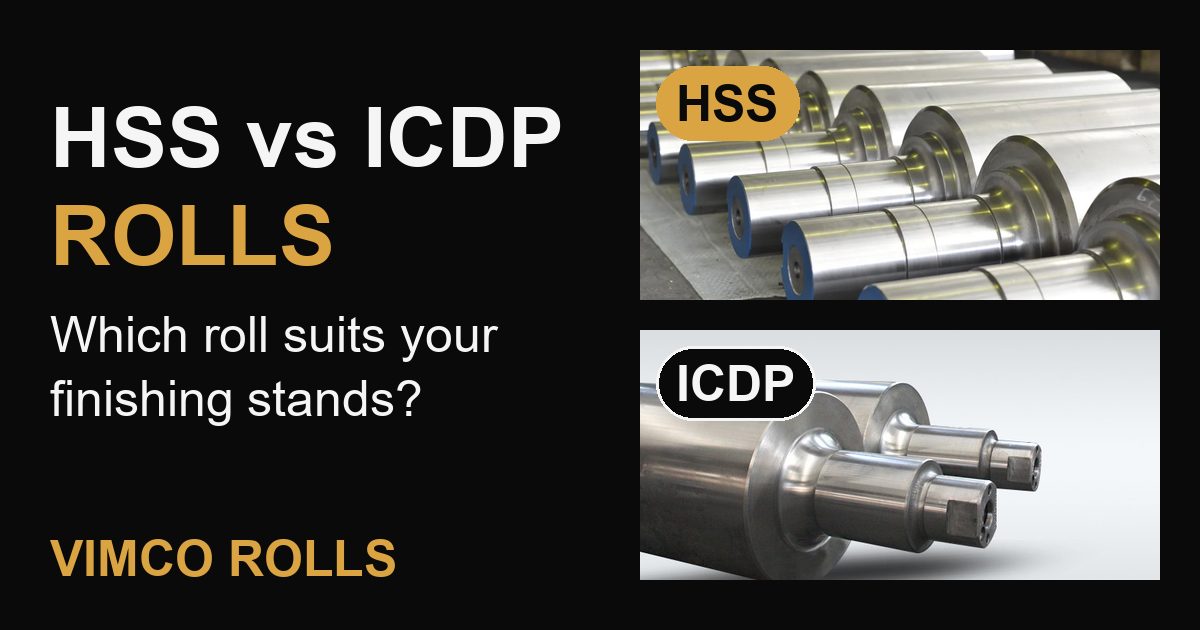
HSS vs ICDP rolls comes down to one trade-off. HSS (High Speed Steel) rolls resist wear better and hold their groove or profile far longer. ICDP (Indefinite Chill Double Poured) rolls carry free graphite, which makes them better at resisting strip sticking, thermal cycling and mill incidents. Which one belongs on a stand depends on the mill type and the stand position, and the right way to compare them is cost per tonne rolled, not price per roll.
Key takeaways
- HSS rolls have a tempered martensitic matrix packed with hard MC, M2C and M6C carbides. ICDP rolls have an alloyed cast iron shell with carbides and free graphite.
- In peer-reviewed hot strip mill work, a new-type HSS roll showed more than twice the wear resistance of carbide-enhanced ICDP (Hattori, Oda and Maeda, 2014). Roll makers, including Vimco Rolls, publish higher figures of 3 to 5 times for single-groove tonnage.
- On hot strip mills, conventional HSS has been used in the front and middle finishing stands, and ICDP in the later stands, because of ICDP's crack and sticking resistance.
- On TMT bar and wire rod mills, Vimco Rolls lists HSS for finishing stands and for the slitting and dog-bone stands of rebar mills, and ICDP for intermediate and finishing stands.
- No neutral source publishes an HSS-to-ICDP price ratio, so judge a switch on roll cost per tonne: tonnes rolled per groove and over the roll's life.
What is the difference between HSS and ICDP rolls?
The difference is in the working layer. An HSS roll's shell is a high-carbon high speed steel whose hardness comes from very hard alloy carbides in a martensitic matrix. An ICDP roll's shell is an alloyed cast iron that holds carbides and a controlled amount of free graphite. The carbides give both rolls their wear resistance. The graphite, which conventional HSS does not have, is what gives ICDP its resistance to sticking and thermal shock.
Both are composite rolls: a hard, wear-resistant shell is cast around a tougher core, so the barrel surface does the rolling while the core and necks carry the load. The two grades also come from different eras. IspatGuru dates ICDP rolls to around 1930 for hot rolling, with carbide-enhanced ICDP grades arriving in the late 1990s, and the first use of high speed tool steel materials in rolls to 1985.
What is an HSS roll?
An HSS roll is a rolling mill roll whose working layer is made of high speed steel, an alloy steel rich in molybdenum, vanadium, tungsten and chromium. On its HSS rolls page, Vimco Rolls describes these elements forming eutectic and secondary carbides of the MC, M2C and M6C types, evenly distributed in a tempered martensitic matrix, which gives the roll its wear resistance, thermal crack resistance and resistance to surface roughening.
Vimco Rolls publishes two grades, Semi-HSS and HSS, both at 80 to 85 Shore C. The HSS grade carries 1.5 to 2.2 percent carbon and up to 9 percent vanadium, the element that forms the hardest MC carbides. Vimco's page also notes that in hot strip rolling a thin, adherent oxide film forms on the roll surface, which adds to wear resistance and helps keep the strip surface consistent.
What is an ICDP roll?
An ICDP roll is a double-poured composite roll with a hard indefinite chill cast iron shell and a softer grey or nodular iron core. "Indefinite chill" describes how the structure changes: IspatGuru explains that the surface layers of indefinite chill rolls already contain very small graphite particles, and the structure changes smoothly into the grey iron core.
On its ICDP rolls page, Vimco Rolls describes rolls made by a combination of spin and static casting, with a bainitic matrix at the surface and flake graphite that improves thermal conductivity and roll life. Vimco lists grades IC-III, IC-IV and IC-V, with shell carbon of 3.0 to 3.6 percent and nickel of 2.0 to 4.8 percent. A 2021 study in the journal Metals (Cofiño-Villar, Alvarez-Antolin and Alvarez-Perez) describes a typical hot strip mill ICDP work layer as a martensitic white cast iron with 4.5 percent nickel, 1.7 percent chromium and 0.7 percent niobium, whose M3C and MC carbides provide wear resistance while graphite particles improve the roll's behaviour under thermal cycling.

HSS vs ICDP rolls: side-by-side comparison
The table sets the two grades against each other on the points mills ask about most. Vimco Rolls figures come from its product pages; other rows are attributed in the column.
| Attribute | HSS rolls | ICDP rolls |
|---|---|---|
| Full form | High Speed Steel | Indefinite Chill Double Poured |
| Working layer | High-carbon high speed steel | Alloyed indefinite chill cast iron |
| Matrix | Tempered martensite (Vimco Rolls) | Bainitic at the surface (Vimco Rolls); martensitic in some hot strip grades (Metals, 2021) |
| Hard phases | MC, M2C, M6C carbides | M3C (cementite) and MC carbides |
| Free graphite | None in conventional grades | Yes, flake graphite in the working layer |
| Key alloying (Vimco grades) | C 1.5 to 2.2%, Cr 3 to 8%, Mo 2 to 8%, V 2 to 9% (HSS grade) | C 3.0 to 3.6%, Ni 2.0 to 4.8%, Cr 0.7 to 2.0% (IC-III to IC-V shell) |
| Published hardness | 80 to 85 Shore C (Semi-HSS and HSS) | Grade dependent |
| Main strength | Wear resistance, groove and profile retention | Resistance to sticking, thermal cycling and mill incidents |
| Main limitation | Lower crack resistance in conventional grades | Faster wear, shorter campaigns |
| Typical hot strip mill position | Front and middle finishing stands | Later finishing stands |
| Long-product positions listed by Vimco Rolls | Finishing stands of TMT bar and wire rod mills; slitting and dog-bone stands of rebar mills | Intermediate and finishing stands of wire rod, TMT and structural mills |
Which lasts longer, HSS or ICDP rolls?
HSS rolls last longer in wear. Every comparison reviewed for this article agrees on the direction; the size of the gap depends on who measured it and on which mill. The table below separates peer-reviewed results from figures that roll makers publish.
| Figure | Compared against | Mill type | Source (type) |
|---|---|---|---|
| More than 2 times the wear resistance | Carbide-enhanced ICDP (E-ICDP) | Hot strip mill, later finishing stands | Hattori, Oda and Maeda, 2014 (peer-reviewed) |
| 3 to 5 times the single-groove steel passing capacity | High-nickel-chromium rolls | Not stated | Vimco Rolls HSS page (manufacturer) |
Why the published multiples differ
The figures measure different things. A laboratory or trial wear resistance ratio compares material loss under set conditions. A single-groove tonnage figure counts how much steel a groove rolls on a real mill before it goes out of tolerance, which also depends on roll cooling, pass design, stock temperature and how often the mill has incidents. The comparison grade matters too: carbide-enhanced ICDP is a harder benchmark than an ordinary nickel-chromium indefinite chill roll. When a supplier quotes a multiple, ask what it was measured against, on which stand, and over how many campaigns.
Where does ICDP still beat HSS?
ICDP still beats conventional HSS where a stand needs resistance to sticking and cracking more than it needs wear life. ICDP rolls are known for strip sticking resistance, a property Hattori, Oda and Maeda (2014) had to engineer into their new HSS grade, and the graphite particles in the ICDP shell improve its behaviour under repeated heating and cooling (Metals, 2021). Conventional HSS has no graphite.
That is why, on hot strip mills, ICDP has held the later finishing stands. Hattori, Oda and Maeda (2014) state that conventional HSS rolls, despite excellent wear resistance, had only been applied in the front or middle finishing stands, not the later ones, because of inferior crack resistance. Their new HSS grade was developed specifically to match ICDP's strip sticking resistance so it could move into those stands. IspatGuru warns that the wrong roll grade in the last finishing stands can lead to catastrophic sticking.
ICDP is not problem-free in return. IspatGuru notes that banding typically appears on ICDP work rolls in the early finishing stands of hot rolling mills, even after rather short campaigns, which is one reason mills moved higher-wear grades into those positions.
HSS or ICDP: which roll for which stand?
The answer changes with the mill type. Most published comparisons describe hot strip mills. Bar, rebar and wire rod mills use grooved rolls and have different stand demands, so they are treated separately below. For how the stock moves through roughing, intermediate and finishing groups, see Steel Rolling Process Explained.
Hot strip mills
Conventional HSS work rolls go in the front and middle finishing stands, where wear drives roll changes. ICDP work rolls, including carbide-enhanced grades, stay in the later finishing stands, where sticking and crack resistance come first. Newer HSS grades aim to move into the later stands, per Hattori, Oda and Maeda (2014).
TMT bar and rebar mills
Vimco Rolls lists HSS rolls for the finishing stands of TMT bar mills and for the slitting and dog-bone stands of rebar mills, where groove shape has to be held accurately for rib geometry and size. ICDP rolls are listed for the intermediate and finishing stands of TMT mills.
Wire rod mills
Vimco Rolls lists HSS for the finishing stands of wire rod mills and ICDP for the intermediate and finishing stands. For high-speed finishing mills, Vimco lists tungsten carbide roll rings as roll sleeves, at 78 to 88 HRA depending on grade.
| Mill type | Stand position | HSS | ICDP | Source |
|---|---|---|---|---|
| Hot strip mill | Front and middle finishing stands | Conventional HSS used | Used | Hattori et al., 2014 |
| Hot strip mill | Later finishing stands | New-type HSS grades only | Established choice | Hattori et al., 2014 |
| TMT bar mill | Intermediate stands | Not listed | Listed | Vimco Rolls product pages |
| TMT bar mill | Finishing stands | Listed | Listed | Vimco Rolls product pages |
| Rebar mill | Slitting and dog-bone stands | Listed | Not listed | Vimco Rolls product pages |
| Wire rod mill | Intermediate stands | Not listed | Listed | Vimco Rolls product pages |
| Wire rod mill | Finishing stands | Listed | Listed | Vimco Rolls product pages |
| Structural mill | Intermediate and finishing stands | Not listed | Listed | Vimco Rolls product pages |

Is HSS worth the higher price? Cost per tonne, not price per roll
HSS is worth it on a stand where it rolls enough extra tonnes to cover any price difference and still cut roll changes. No neutral source we found publishes a price ratio between HSS and ICDP, and prices vary with size, grade and order, so a quoted ratio is not a sound basis for the decision.
The sound basis is roll cost per tonne of finished steel:
Roll cost per tonne = roll price ÷ total tonnes the roll rolls over its life. Total tonnes = tonnes per groove campaign × number of campaigns the roll body allows before it reaches scrap diameter.
A roll with a higher price can still have the lower cost per tonne if each groove rolls several times more steel. The saving is also larger than the roll bill alone: fewer groove and roll changes mean fewer stoppages, which Vimco Rolls lists as a main benefit of HSS alongside lower roll consumption. Between campaigns, rolls are dressed in the roll turning and grinding shop, as IspatGuru describes, so the roll shop is part of the decision too.
What should a mill check before switching from ICDP to HSS?
Check the numbers you already have, the stand, and the roll shop. Five questions cover most of it:
- What does the stand roll per groove today? Record current tonnes per groove and per campaign on ICDP. Without this baseline no trial result can be judged.
- Is the stand limited by wear or by incidents? If grooves go out of size, HSS addresses that. If the stand suffers sticking, cobbles or cracks, the graphite in ICDP may be doing necessary work.
- Where is the stand in the line? Use the stand table above as a starting map for your mill type.
- Is the roll shop ready? Confirm with the roll supplier how HSS rolls should be dressed between campaigns.
- How will the trial be measured? Agree the measure (tonnes per groove, campaigns per roll, stoppage hours) with the roll supplier before the first HSS roll goes in.
Frequently asked questions
What is the full form of HSS and ICDP rolls?
HSS stands for High Speed Steel. ICDP stands for Indefinite Chill Double Poured, sometimes written as Indefinite Chilled Double Poured. Both are composite rolling mill rolls with a hard working shell cast around a tougher core.
Why are ICDP rolls used in the last finishing stands of hot strip mills?
Because of their resistance to sticking and cracking. ICDP rolls have established strip sticking resistance, and the graphite in the shell improves behaviour under thermal cycling (Metals, 2021). Hattori, Oda and Maeda (2014) note that conventional HSS rolls were kept out of these stands because of inferior crack resistance.
Can HSS rolls replace ICDP rolls?
On many stands, yes, but not automatically on all of them. HSS replaces ICDP where wear limits the campaign. On hot strip mills, the later finishing stands have needed new-type HSS grades developed to match ICDP's sticking resistance. On long-product mills, Vimco Rolls lists both grades for finishing stands, so the choice there is made stand by stand.
How much longer do HSS rolls last than ICDP rolls?
It depends on the mill and the comparison grade. A peer-reviewed hot strip mill study found more than twice the wear resistance of carbide-enhanced ICDP (Hattori, Oda and Maeda, 2014). Roll makers, including Vimco Rolls, publish 3 to 5 times the single-groove steel passing capacity of high-nickel-chromium rolls.
Does Vimco Rolls make more than one HSS grade?
Yes, two: Semi-HSS and HSS. They differ mainly in carbon and alloy content. In Vimco Rolls' published grades, Semi-HSS carries 0.6 to 1.2 percent carbon and HSS carries 1.5 to 2.2 percent, with both at 80 to 85 Shore C. Full grade chemistry is on the HSS rolls page.
Planning a switch to HSS on a finishing stand?
Vimco Rolls Pvt Ltd has made rolls for rolling mills since 1972 and produces both HSS and ICDP grades at its plant in Dera Bassi, near Chandigarh. Share your mill type, stand position and current tonnes per groove, and we will recommend a grade for the trial.
Enquire about HSS rollsSources
- Hattori T., Oda N., Maeda N. (2014). New type of HSS work roll for later stands in hot strip mill finishing trains. Chernye Metally. rudmet.ru
- Cofiño-Villar A., Alvarez-Antolin F., Alvarez-Perez C.H. (2021). Improvement in the Resistance to Wear of Work-Rolls Used in Finishing Stands of the Hot Strip Mills. Metals 11(11), 1873. doi.org/10.3390/met11111873
- IspatGuru. Abnormalities and Failures of Rolling Mill Rolls. ispatguru.com
- IspatGuru. Rolling Mills Rolls. ispatguru.com
- Vimco Rolls product pages: HSS rolls, ICDP rolls, tungsten carbide roll rings.
Discuss this for your mill
Share your stand details and we will suggest the roll grade for it.