
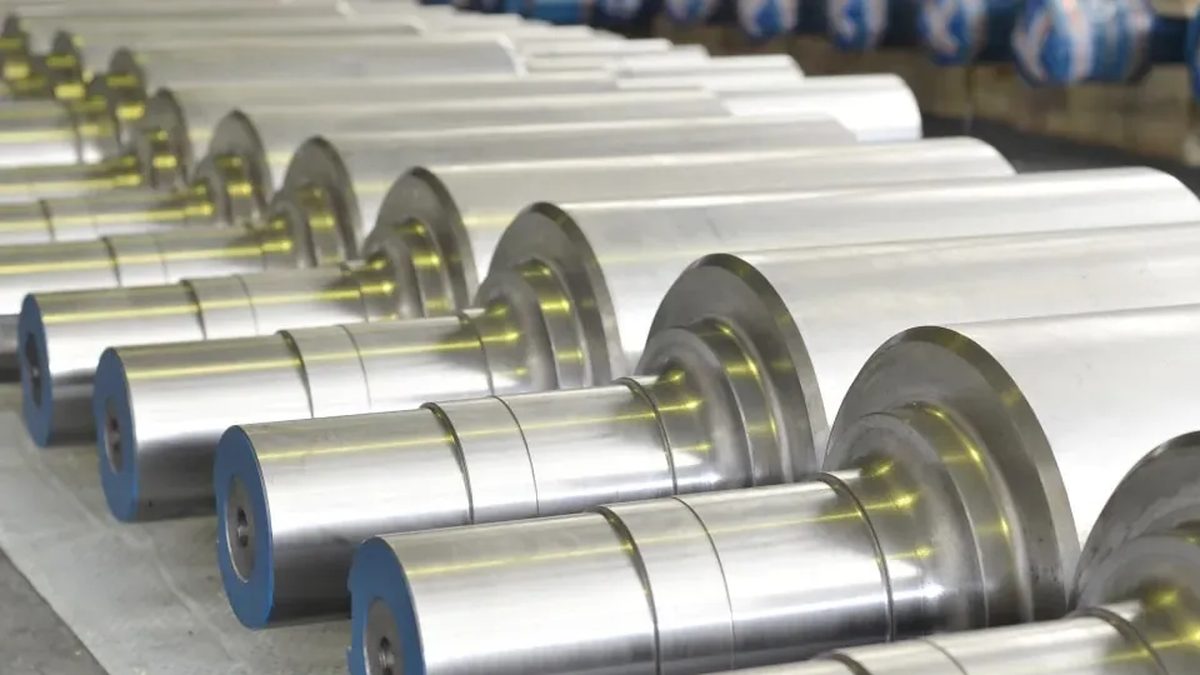
A roughing mill is the first group of stands in a hot rolling line. It takes the billet straight from the reheating furnace and makes the heaviest reductions in the whole mill. The rolls in those stands carry the highest loads, meet the hottest stock and take a shock at every bite, so they are chosen for toughness first and hardness second.
The sections below cover what the roughing stands do to a roll, which roll grades are used there in each type of mill, and how to choose between them. It is written for TMT bar, wire rod, section and strip mills.
Key takeaways
- In roughing stands a crack or a break can end a roll's life long before wear does, so toughness and resistance to fire cracking come before surface hardness.
- The right grade depends on the mill type. TMT bar and wire rod mills choose between adamite and SG iron pearlitic. Medium and heavy section mills add alloy cast steel and graphitic steel. Bar mills also use forged rolls.
- Vimco Rolls roughing grades run from 30 Shore C (alloy cast steel) to 65 Shore C (SG iron pearlitic). Hardness can step up stand by stand, from the first roughing stand to the last.
- At 50 to 55 Shore C an adamite roll and an SG iron pearlitic roll have the same hardness. There the choice is between a steel roll and an iron roll, not between two hardness numbers.
- Even hardness from the surface down into the working layer matters on roughing rolls, because their grooves are deep and every redress takes the groove closer to the core.
What a roughing mill does
A hot rolling line works in three stages. The roughing stands come first, ahead of the intermediate and finishing stands, and the steel rolling process guide covers the whole line.
The billet enters the roughing group hot, thick and short. Each roughing pass takes a large bite out of its cross section. Steel does not change volume as it is rolled, so every reduction makes the stock longer and faster. The roughing stands therefore run slowly and carry the biggest rolling force and torque in the mill.
In a continuous mill the stands are set one after another, and many lines alternate horizontal and vertical stands so the stock is squeezed from both sides in turn.
At this point nobody is judging the surface of the bar. Scale, a rough skin and an uneven head end are all still there. What matters is that the roughing group breaks the billet down to a section the intermediate stands can take, pass after pass, without a cobble or a broken roll.
What the roughing stands do to a roll
Four conditions set roughing stands apart from the rest of the mill, and each one asks something of the roll.
| Condition in the roughing stand | What it does to the roll | What the roll needs |
|---|---|---|
| Heaviest reduction per pass, at low speed | The highest load and torque, on the barrel and on the necks | Strength and toughness, so the roll does not break |
| A hard bite as each billet enters | A shock load at the start of every pass, worse with a cold or uneven head end | Toughness, the ability to take impact without cracking |
| The hottest stock in the line, with water cooling on the roll | The groove surface heats in the bite and cools as it turns away, on every revolution | Resistance to thermal fatigue and fire cracks |
| Large, deep grooves | Each redress takes the groove bottom closer to the centre of the roll | Even hardness from the surface into the working layer |
Notice what is missing from the list: a hard, wear-resistant skin. Roughing grooves do wear, but a roughing roll that is too hard cracks or snaps more readily, and a broken roll ends its life at once. It also stops the line: an unplanned roll change is downtime for every product size the mill rolls. That is why roughing grades sit at the soft end of the hardness range, a point the Roll Hardness Explained guide covers in more depth.
Roll grades used in roughing stands, by mill type
No single grade suits every roughing mill. A TMT bar mill, a heavy section mill and a hot strip mill load their roughing stands in different ways. Below, every Vimco Rolls roughing grade is set against the mills it is made for, as given on our product pages.
| Mill type | Roughing stand grades (Vimco Rolls) | Hardness range |
|---|---|---|
| TMT bar and wire rod mills | Adamite (AD-42, AD-47, AD-52); SG iron pearlitic (SGP-52, SGP-57, SGP-62) | 40 to 55 Shore C; 50 to 65 Shore C |
| Hot strip mills | Adamite | 40 to 55 Shore C |
| Medium and heavy section mills | Alloy cast steel (ACS-32, ACS-37); adamite, which section and structural mills use in every stand; graphitic steel (GS-50 and GS-55) where fire cracking is the problem | 30 to 40; 40 to 55; 48 to 57 Shore C |
| Bar mills | Forged rolls (forged MS, EN-8, EN-9, EN-42, Class 2 to 4) | Not published as Shore C |
| Rail, universal beam and billet mills | Adamite | 40 to 55 Shore C |
The chart below puts the cast roughing grades on one hardness scale. It shows two things at a glance: where each material sits, and where two materials overlap.

Adamite or SG iron pearlitic in a TMT or wire rod roughing mill
In TMT bar and wire rod mills, these are the two Vimco Rolls grades listed for the roughing stands. Both resist the heat and shock of roughing. They get there in different ways.
Adamite is a steel roll. It is a hyper-eutectoid steel with 1.0 to 2.0% carbon, alloyed with nickel, chromium and molybdenum. Annealing and controlled tempering give it a fine pearlitic matrix with spheroidised carbides. The alloying adds toughness and resistance to fire cracks.
SG iron pearlitic is an iron roll. Its graphite is in nodules, not flakes, set with carbides in a pearlitic matrix. The nodular form is what gives SG iron its strength and its resistance to thermal and mechanical stress, compared with cast iron that carries flake graphite.
Three differences follow for the roughing mill:
- Hardness band. Adamite covers 40 to 55 Shore C and SG iron pearlitic covers 50 to 65. Adamite reaches lower, for the stands where shock is worst. SG iron pearlitic reaches higher, for the stands where groove wear starts to matter.
- Reach along the line. SG iron pearlitic is also listed for intermediate stands of TMT bar and wire rod mills, so it suits the later roughing stands that hand the stock on to the intermediate group. In these mills adamite is listed for the roughing stands only.
- The overlap. AD-52 and SGP-52 are both 50 to 55 Shore C. A mill choosing in that band is choosing a material, steel or SG iron, at the same hardness. That decision rests on the stand's history: what broke, what cracked and what wore.
The adamite rolls page sets the two side by side in a table of material, structure, grades and stands. Tell us the stand and what you roll, and we will suggest one.
Step the hardness across the roughing group
A roughing mill is not one stand. The first stand meets the full billet and the hardest bite. The last stand meets a smaller, longer section and hands it to the intermediate group. Their rolls should not be the same.
The three grades in each material give the steps. Within adamite, hardness rises from AD-42 to AD-52 as carbon, chromium and nickel rise. Within SG iron pearlitic, it rises from SGP-52 to SGP-62. A mill can start soft and tough at the first stand and move up the scale stand by stand.
The same logic carries on past the roughing group. Published Vimco grades start at 30 to 40 Shore C for the softest roughing grade, and HSS finishing rolls reach 80 to 85.
Why depth hardness matters on roughing rolls
Roughing grooves are large and deep. Each redress removes worn and cracked metal and re-cuts the grooves on a smaller diameter. After a few campaigns the groove bottom is working on metal that was well below the original surface.
If the roll's hardness falls steeply with depth, the late campaigns run on softer metal and the grooves wear faster. On a roll whose hardness stays level, the last campaign behaves like the first. Our hardness chart for adamite shows a fall of only about 3 to 4 Shore C over the first 90 mm from the surface. SG iron pearlitic is made to keep a stable hardness across its working layer.
Ask for the hardness-depth chart, since the surface value alone says little about later campaigns, and ask for the new and scrap diameters. Together they tell you how much usable roll you are buying. The roll life guide shows how to turn that into tonnes.
Section mills, strip mills and bar mills
Medium and heavy section mills have a roughing grade of their own: alloy cast steel. These rolls are hypo-eutectoid steel with 0.5 to 0.8% carbon, chromium and molybdenum, double annealed for toughness and thermal shock resistance, at 30 to 40 Shore C. Where these mills suffer fire cracking, graphitic steel is the alternative. It is similar to adamite, with a small amount of fine graphite that improves wear resistance and resistance to fire cracks.
Hot strip mills use adamite in their roughing stands.
Bar mills also run forged rolls in their roughing stands. Forging aligns and elongates the grain of the metal, and the rolls are annealed after forging. That gives them a higher load-bearing capacity than cast rolls. Every forged roll we make is ultrasonically tested for internal defects.
Roughing roll problems and where to look
When a roughing roll comes out early, the damage on it says what to change. These are the patterns most tied to roughing duty.
| What you see | Likely cause in a roughing stand | What to check first |
|---|---|---|
| Broken barrel or neck | Overload or shock beyond what the grade can take | Billet temperature and head ends, the pass load, and whether the grade is too hard for that stand |
| A network of fine cracks in the groove | Thermal fatigue from heating in the bite and cooling as the roll turns | Even cooling while the roll turns, the water shut off when a hot roll stops, and a grade that resists fire cracks |
| Grooves wear out of size early in the last roughing stands | Wear has become the limit, not shock | A harder grade or a higher grade in the same material for those stands |
| Grooves wear faster with each redress | Hardness falling with depth in the working layer | The grade's hardness-depth chart and how much is removed at each redress |
The wider list of failure signs and their causes is in How to Increase Roll Life in a Bar and Wire Rod Mill.
What to send with an enquiry for roughing rolls
- Mill type and product: TMT bar, wire rod, section, strip or rail, and the sizes you roll.
- Stand position: which roughing stand, counted from the furnace end.
- Roll drawing or dimensions, with the groove or pass drawing if you have it.
- The grade and hardness you run now, and what limits it: breakage, fire cracks or wear.
- Your roll record: tonnes per groove and how much diameter comes off when you redress, if you keep one.
Our quality page lists the testing behind each roll, from hardness and ultrasonic checks to microstructure, spectrometer and wet chemical analysis.
Frequently asked questions
What does the roughing mill do in a rolling line?
It is the first group of stands after the reheating furnace. The roughing mill makes the heaviest reductions in the line, at low speed and high load, and breaks the billet down to a section the intermediate stands can roll. The intermediate and finishing stands then bring it to final size.
Which rolls are used in the roughing stands of a TMT bar mill?
Adamite rolls, grades AD-42 to AD-52 at 40 to 55 Shore C, and SG iron pearlitic rolls, grades SGP-52 to SGP-62 at 50 to 65 Shore C. The same two grades are used in the roughing stands of wire rod mills.
Why are roughing rolls softer than finishing rolls?
Because shock and heat, more than wear, decide the life of a roughing roll. A softer, tougher roll takes the impact of each bite without cracking. Finishing rolls see light reductions but need a groove that stays in size over many tonnes, so they are made much harder.
Are forged rolls stronger than cast rolls?
Forging aligns and elongates the grain structure, which gives forged rolls a higher load-bearing capacity than rolls made from cast material. That is why bar mills use them in roughing stands. Vimco Rolls makes forged MS, EN-8, EN-9, EN-42 and Class 2 to 4 forged rolls, each ultrasonically tested.
Can the same roll grade be used in roughing and intermediate stands?
Yes. SG iron pearlitic rolls are listed for both the roughing and the intermediate stands of TMT bar and wire rod mills. A lower grade can run in the roughing stands and a higher grade further down the line.
Choosing rolls for your roughing mill?
Vimco Rolls Pvt Ltd has made rolling mill rolls at Dera Bassi, Punjab, since 1972. Share your mill type, which roughing stand it is and what limits your rolls today, and our team will recommend a grade.
Send your roughing stand detailsDiscuss this for your mill
Share your stand details and we will suggest the roll grade for it.