
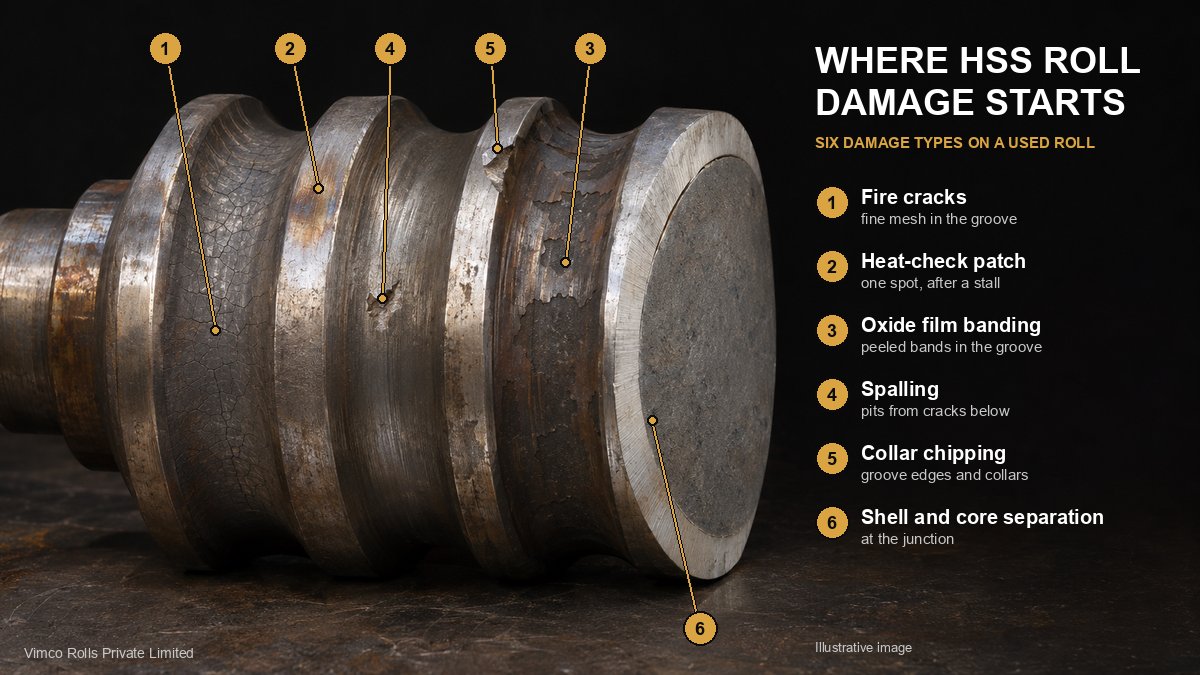
HSS roll damage is any defect that takes a high-speed steel (HSS) roll out of service before its groove has worn to size: crazed groove surfaces, patches where the working surface peels, chipped collars, pieces that break away, and cracks deep enough to make a roll unsafe. Each type leaves its own marks on the roll. Reading those marks tells the roll shop where to look for the cause, in the roll or in the mill.
HSS rolls from Vimco Rolls Private Limited run at the delivery end of bar and wire rod lines: in finishing stands rolling TMT bar or wire rod, and in the slitting and dog-bone passes of rebar mills. Below are the six damage types a roll shop is most likely to find on rolls from those stands, the signs of each, and what to record before a damaged roll is redressed or scrapped.
Key takeaways
- HSS grooves wear slowly, so on these rolls a pass is more often taken out by cracks, peeling or chipping than by wear.
- A fine network of fire cracks in the groove is a normal result of heating and cooling. It turns into a problem when it deepens or when the redress leaves part of it behind.
- Coarse cracks concentrated in one patch of a groove usually point to a stall or a cobble. Peeling in bands points to uneven cooling.
- Where the damage appears matters as much as what it looks like: one groove or all of them, one stand or several, the first campaign or a late one.
- Before a damaged roll is reground, record the stand, the groove, the tonnes rolled and the mill events of that campaign. Without that record, the cause is hard to prove later.
Why damage decides the life of an HSS pass
An HSS roll has a working layer of steel with large additions of molybdenum, vanadium, tungsten and chromium. MC, M2C and M6C carbides form from those alloys and are held in tempered martensite. Supplied hardness for our HSS rolls is 80 to 85 Shore C.
That structure is the reason mills fit HSS in the finishing stands. The groove has high wear resistance and keeps its profile, and we estimate that an HSS roll stays in useful service 5 to 6 times as long as conventional rolls. Because groove wear is slow, damage is more likely than wear to decide when a pass comes out.
The same hardness also shapes how the roll gets damaged. A hard, carbide-rich working layer resists abrasion well but gives less warning under thermal shock or impact. A softer grade under the same abuse often deforms or wears faster. On an HSS groove, the same abuse tends to show up as cracks or chips. How Shore C readings are taken, and what they leave out, is covered in our roll hardness guide.
Six types of HSS roll damage at a glance
The table sums up what each damage type looks like on the roll, where it usually starts, and whether the first place to look for the cause is the roll or the mill.
| Damage type | What you see | Where it starts | Look first at |
|---|---|---|---|
| Fire cracks | A fine, even mesh of hairline cracks across the groove contact zone | Surface of the groove, where the hot bar touches | Cooling and the heat cycle of the stand |
| Heat-check patch after a stall | Coarse, deeper cracks in one patch of one groove, sometimes with discoloration | The spot where hot stock stood still in the pass | Mill events: cobbles, stalls, water failures |
| Oxide film banding | Bands or patches where the dark surface film has peeled, leaving a rough groove | Groove surface, often in rings around the roll | Uneven cooling and roll temperature |
| Spalling | Pieces of the working layer broken out, leaving pits with sharp edges | Below the surface, from cracks that run parallel to it | Cracks left after redressing, overload, then the roll |
| Collar breakage and groove chipping | Broken collar between grooves, or chips out of the groove edge | Groove edges, collars, the slitting wedge | Pass fill, guide alignment, groove corner shape |
| Shell and core separation | A large area of the working layer lifting or coming away in one piece | At the junction of the working layer and the core | The roll first, then severe overload |
1. Fire cracks in the groove
Each time the groove turns into the bite, the hot bar heats its surface. A moment later the water spray quenches it before the next contact. The roll surface goes through thermal expansion and contraction on every revolution of a hot rolling campaign, and over a campaign this cycle crazes the groove with fine cracks. The result is called fire cracking or thermal fatigue cracking.
How to recognise it. The cracks form a fine, fairly even network, like the crazing on old glaze, spread across the part of the groove that touches the bar. Collars that never touch the stock stay clear.
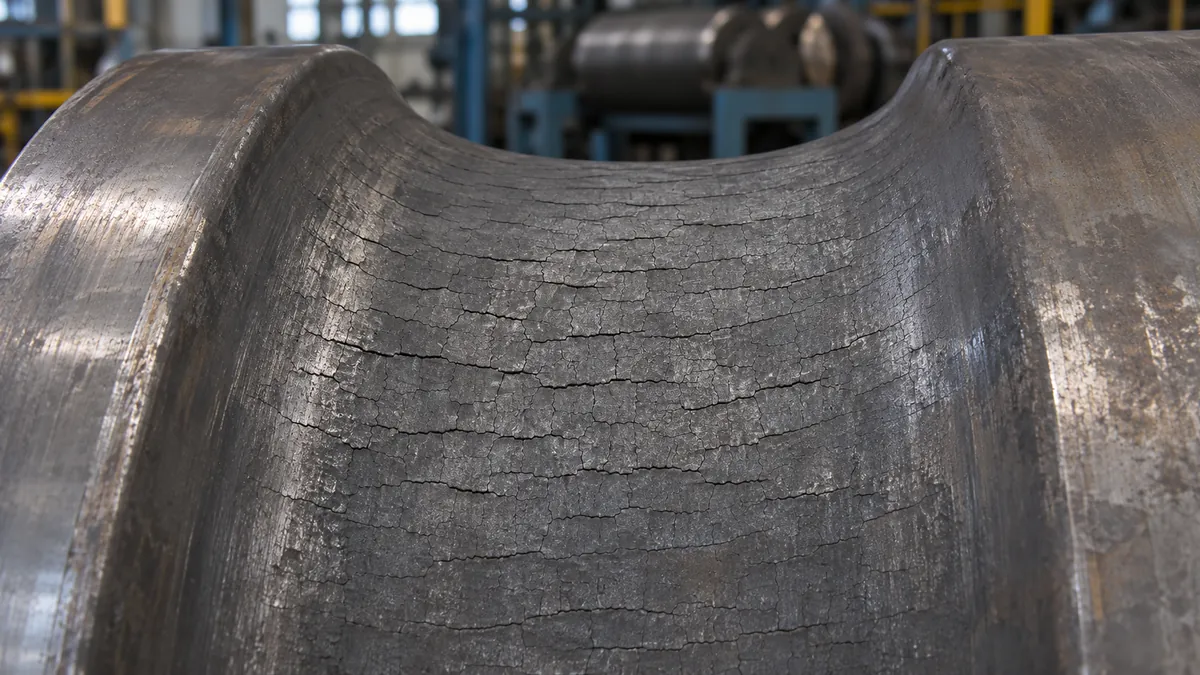
When it matters. Some fire cracking is expected on any roll that works hot. It becomes a problem in two cases. The first is when the network is coarse or deep, which shows that the heat cycle is harsher than the roll was chosen for. The second is when the redress removes the visible cracks but leaves their roots behind. The next campaign then starts with cracks already in place.
What to check. Look at whether the cooling covers the full width of the groove and runs steadily through the campaign. Compare the crack pattern across stands. A coarser network in one stand than in its neighbours points at that stand's cooling or loading.
2. A heat-check patch after a stall or cobble
When the line stops with hot stock in the pass, or a cobble wraps the roll, one small part of the groove stays in contact with hot steel far longer than the normal bite. That spot overheats while the rest of the roll stays cool. When the stock is cleared and the water reaches the spot again, the sudden cooling adds a second shock.
How to recognise it. The cracks are coarser and deeper than the normal fire-crack mesh, and they sit in one patch of one groove instead of running round the roll. The patch may show heat discoloration.
What to check. Match the position of the patch with the mill log for that campaign: cobbles, stalls, water supply failures and emergency stops. A roll with this damage should be crack-tested after it has cooled and before any decision to reuse the pass. Cutting the cooling to an overheated roll and then turning it back on in one go makes the damage worse, so the mill's cobble procedure should say how cooling is handled while a cobble is cleared.
3. Oxide film banding and peeling
In service, an HSS groove builds a thin, dark oxide film on its working surface. A thin, even film is normal and helps the groove run smoothly. Trouble starts when the film grows unevenly and then peels away in patches.
How to recognise it. Parts of the groove look dull and rough next to areas that are still smooth and dark. The peeled areas often run in bands or rings around the roll. The surface quality of the rolled material suffers too: bars rolled in that groove can show marks that follow the same pattern.
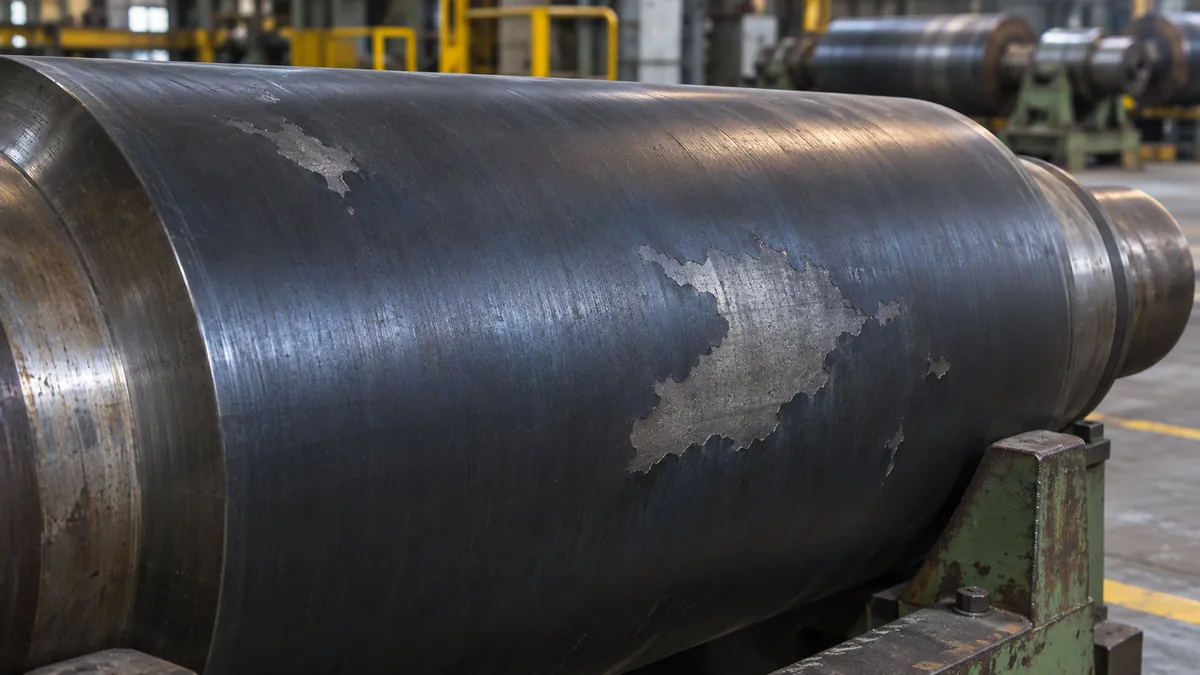
What usually lies behind it. The film depends on the surface temperature of the roll. Where some parts of the groove run hotter than others, because the water does not reach them evenly or the nozzles are partly blocked, the film grows thicker there and is more likely to break away.
What to check. The spray pattern across the groove, nozzle condition and water quality. Compare the positions of the bands with the positions of the nozzles. The roll life guide covers cooling water in more detail.
4. Spalling
Spalling is the loss of a piece of the working layer. It usually starts below the surface, where repeated rolling load drives a crack parallel to the surface. When that crack joins a surface crack, the piece above it breaks away.
How to recognise it. A pit or crater with sharp edges, often with a flat floor that follows the line of the crack. Small spalls can sit at the end of a fire crack. Large ones can take out most of a groove.
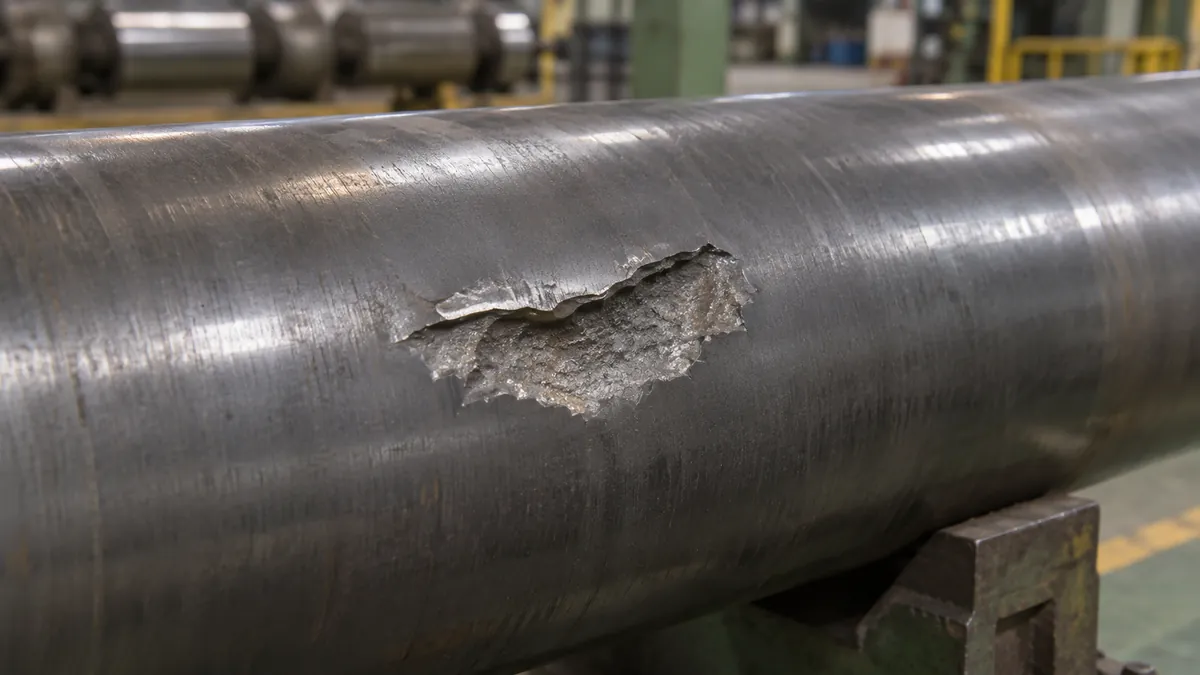
What usually lies behind it. The most common route is a crack that survived the previous redress and kept growing under load. Heavy reductions, high rolling force from overfilled passes, and repeated cobbles in that stand all add load. Where no mill cause is found, the roll itself should be examined: an internal flaw in the roll body, or a working layer with uneven hardness.
What to check. Record the position and depth of the spall and how many campaigns that roll has completed. A spall on a roll's first campaign points more strongly to the roll than one that appears after several redresses.
5. Collar breakage and groove chipping
The collars between grooves and the edges of each groove are the thinnest parts of the working surface. They take side loads that the groove bottom does not.
How to recognise it. Chips missing from the groove edge, cracks running across a collar, or a collar broken off completely. In the slitting stands of a rebar mill, look at the wedge that splits the bar, where stress is concentrated at a narrow point.
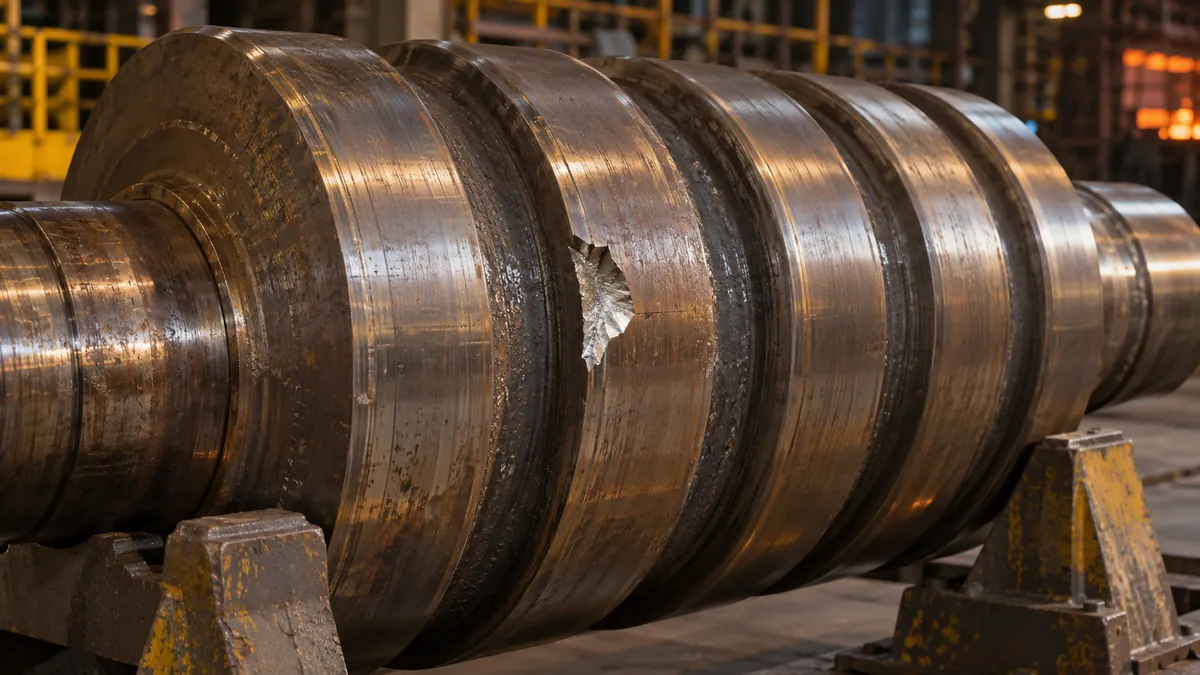
What usually lies behind it. A pass that overfills pushes steel against the collar and raises friction at the groove edge. Guides that are worn or misaligned feed the bar off centre. Groove corners cut too sharp concentrate stress. Fire cracks left at the groove edge by an incomplete redress give a chip an easy place to start.
What to check. Bar size coming from the previous stand, guide condition and alignment, and the corner radii on the roll drawing. If the same collar breaks on different rolls, the cause is almost certainly in the pass or the guides.
6. Shell and core separation
Many hard-faced rolls are built as composite rolls: a working layer of one material joined to a core of a tougher one. The joint between the two has to carry the full rolling load.
How to recognise it. A large area of the working layer lifts or comes away in one piece, deeper than a normal spall, with a fracture surface at the junction between the two materials.
What usually lies behind it. The quality of the joint made during casting, or stresses left in the roll by heat treatment. Severe overload can also cause it. This is the damage type where the roll maker should be involved first. Keep the roll and the broken piece and send photos of the fracture surface.
Roll side or mill side: clues from where the damage appears
The same crack can come from the roll or from the rolling mill. Where and when it appears helps to tell them apart.
| What you observe | Points more towards |
|---|---|
| The same damage on rolls from different batches in the same stand | The stand: cooling, guides, pass design or load |
| Damage on one roll only, while rolls from the same batch run normally elsewhere | That roll's history in the mill, then the roll |
| Damage in one groove only, at one spot | A mill event at that point: stall, cobble, guide fault |
| Damage evenly round the roll in every groove | Cooling or a stand-wide condition |
| Damage on the first campaign of a new roll | The roll should be examined |
| Damage that appears after several redresses | Cracks left behind by earlier redresses |
| Damage that started after a change to the pass schedule or product mix | The new pass or reduction |
What the roll shop should do before a damaged roll goes back in
- Photograph it first. Take photos before the roll is turned or ground, with a scale in the frame. A redress destroys the evidence.
- Crack-test after the roll has cooled. Crack detection on a hot roll can miss cracks or misread them. Test again after the redress to confirm that no crack is left.
- Remove the whole crack. Taking off only what is visible leaves the roots that start the next failure. The roll life guide covers redressing practice.
- Keep a record for each groove. Tonnes rolled, the reason the campaign ended, and the cobbles and stalls in that stand. Patterns only show up across several campaigns.
- Check hardness after deep redressing. Hardness changes with depth below the original surface, so a deeply redressed roll should be checked before it goes back on a demanding stand.
What to send us about a damaged HSS roll
If a Vimco roll has failed early, or you want a second opinion on a roll from your stands, send:
- Photos of the damage before any redress, plus a wider photo showing where it sits on the roll.
- Mill type, plus the stand position: finishing, slitting or dog-bone.
- The roll drawing, the tonnes rolled in that campaign, and the number of earlier campaigns.
- The cooling arrangement on that stand, and any cobbles, stalls or water failures during the campaign.
The lab at our plant runs ultrasonic flaw detection, hardness tests on portable and bench testers, microstructure checks under a metallurgical microscope, and chemical analysis on an optical emission spectrometer. Before a roll leaves the plant we check its hardness, its surface finish and its dimensions. Details of the lab are on our quality page. For the choice between HSS and ICDP on a finishing stand, see HSS vs ICDP rolls, and for the other rolls in that part of the mill, the finishing mill rolls guide.
Frequently asked questions
Are fire cracks on an HSS roll normal?
A fine, shallow network of fire cracks is a normal result of the heating and cooling every hot roll goes through. Watch for a network that is coarser than usual, cracks concentrated in one patch, and cracks that survive the redress. Each of these needs attention.
Why does the groove of an HSS roll turn rough during a campaign?
The most common reason is the oxide film on the groove peeling unevenly. That usually follows uneven roll temperature, for example when the cooling water does not cover the groove evenly. Check the spray pattern and the nozzles first.
Can a cracked HSS roll be used again?
It can, if the redress removes the cracks completely and a crack test after redressing confirms it. The roll must also still be within its usable diameter and hardness. A roll with shell and core separation, or a crack that runs deep into the body, should not go back into the mill.
Which stands see the most damage on HSS rolls in a rebar mill?
The slitting and dog-bone stands are the ones to watch. The slitting pass splits the bar at a narrow wedge, so load and heat are concentrated at a few points of the groove. Collars and groove edges in those stands need close inspection at every roll change.
How long should an HSS roll last?
Our estimate for HSS rolls is a useful life 5 to 6 times as long as conventional rolls. What one stand actually achieves varies with the product, the pass, the cooling and how much damage each redress has to remove.
Seeing damage on your HSS rolls?
Vimco Rolls Pvt Ltd has been in roll making since 1972, and our HSS rolls are melted, heat treated and machined in Dera Bassi, Punjab. Send photos of the damage and the stand details, and we will look at the roll and the operating conditions with you.
Send your roll damage detailsDiscuss this for your mill
Share your stand details and we will suggest the roll grade for it.