
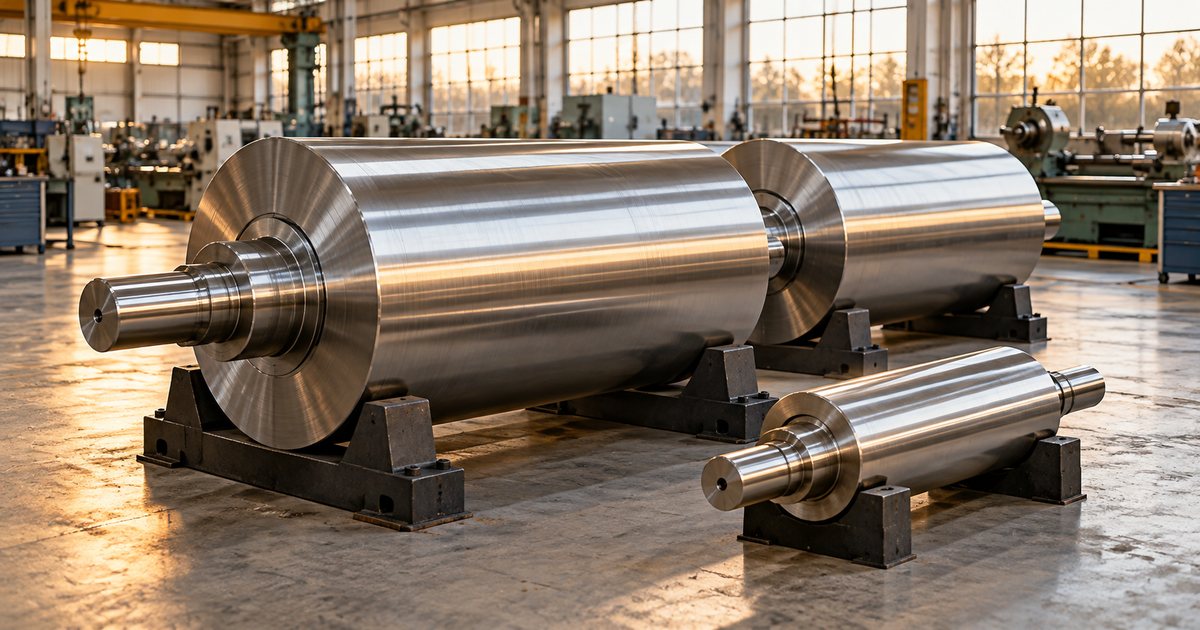
Roll hardness is the first number on every rolling mill roll specification, and for cast rolls it is almost always given in Shore C. The number tells you how hard the working surface is when the roll is new. It does not tell you how the roll wears, cracks or holds its groove, and it changes as the roll is turned down.
This guide explains what the Shore C figure means, how it is measured on a roll, why it falls from the surface towards the core, and how to use it when you choose a roll for a stand.
Key takeaways
- Shore C is a rebound test. A diamond-tipped hammer drops onto the roll surface from a fixed height, and the height it bounces back gives the number. Harder surface, higher bounce. The test is portable and leaves no mark, which is why it suits large rolls.
- Published Vimco Rolls grades run from 30 to 40 Shore C for alloy cast steel up to 80 to 85 Shore C for HSS. Tungsten carbide rings are rated on a different scale, 78 to 88 HRA.
- Hardness is a surface reading. On the hardness-depth charts published for each Vimco grade, HSS and adamite rolls hold their hardness almost flat through the working layer, while an ICDP roll drops sharply at about 40 to 50 mm where the hard shell meets the softer core.
- Harder is not always better. Higher hardness improves wear resistance but raises the risk of roll failure, so softer grades go in roughing stands and harder grades in finishing stands.
- There is no official Shore C to HRA conversion. The only scleroscope conversions in ASTM standards are from the forged-roll C scale to Vickers and to Rockwell C.
What is Shore C hardness?
Shore C hardness is a scleroscope reading. A small diamond-tipped hammer falls inside a glass tube from a fixed height onto the surface being tested. The height of its rebound is read on a graduated scale. The harder the material, the higher the rebound.
The scale was set with 100 as the average rebound from hardened high-carbon steel, and it continues above 100 for harder metals.
Two things make it the natural test for rolls. It is portable, so the instrument comes to the roll instead of a sample going to the laboratory. And in normal use it leaves no mark, so the finished barrel is not damaged by the test. That is why roll hardness is quoted in Shore rather than in a scale that needs an indent.
For rolls there is a specific version of the scale. ASTM E448, the standard for scleroscope hardness testing of metals, defines a forged-roll "C" scale. Its reference is the average rebound from a forged steel roll of accepted maximum hardness.
That is why a roll reading and a general scleroscope reading of the same steel are not the same number. Roll makers and mills compare rolls against each other in Shore C, not against machine parts.
How is hardness measured on a rolling mill roll?
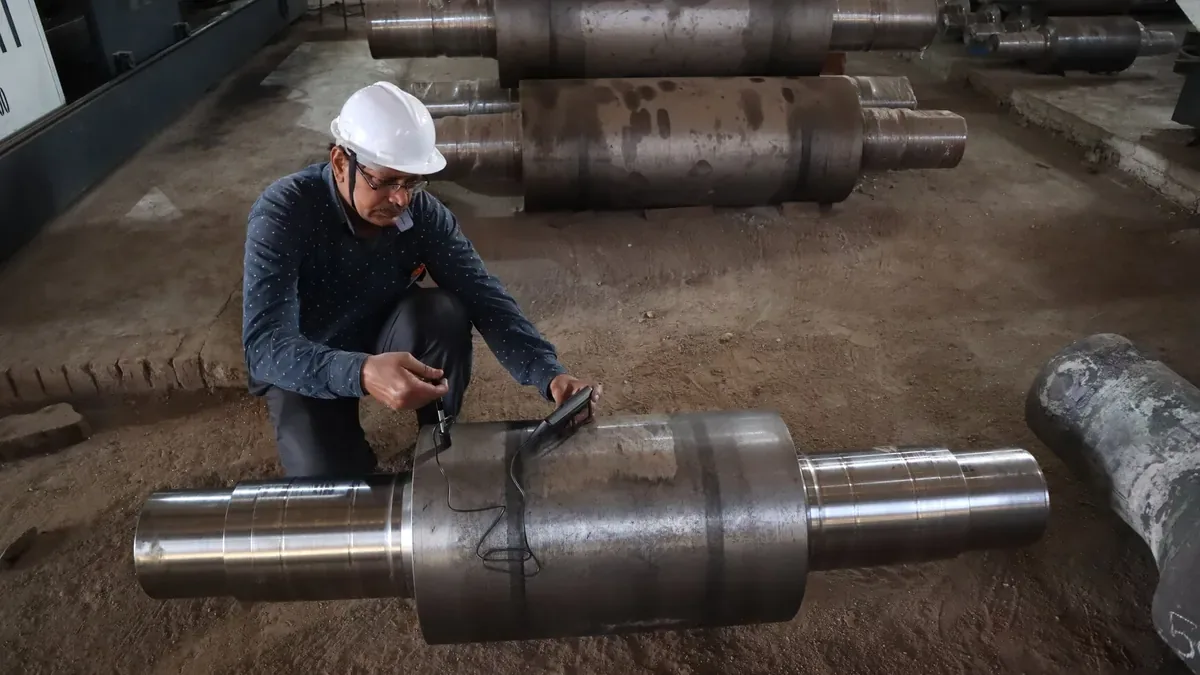
With a portable rebound tester on the barrel, and with laboratory testers on samples. Vimco Rolls lists both on its quality assurance page: hardness testers in portable and laboratory sets, alongside the metallurgical microscope, ultrasonic testing machine and the chemical laboratory. The portable reading is taken on the machined barrel of the finished roll; the laboratory sets are used on test pieces and sections.
One reading is never the whole story. The surface is cleaned and the instrument set squarely on the barrel. Readings are then taken at several points along the length and around the circumference, because a rebound reading is sensitive to surface finish, barrel curvature, how the roll is supported and the operator's technique.
The figure on a specification is therefore a range, such as 60 to 65 Shore C for a grade, not a single value. You will often see it written as HSC or HSc. A test certificate should show where the readings were taken and that they sit inside the ordered range.
Why does roll hardness fall from the surface to the core?
Because a roll is not one material all the way through. In a cast roll the surface cools fastest in the mould, which gives it the finest, hardest structure. The structure coarsens and softens towards the centre.
In a double-poured roll such as ICDP, a hard shell alloy is cast around a softer, tougher core, so the hardness steps down where the two meet. In a steel roll such as adamite, the heat treatment reaches the whole section, so hardness is nearly uniform across the barrel.
That gradient matters because a roll is turned down between campaigns. Each redress removes some of the working layer. A roll that reads 75 Shore C when new will read lower after several campaigns, and the rate of that drop depends on the grade. For indefinite chill rolls the usual figure is a drop of about 1 degree Shore per 10 mm of depth, then faster towards the core, with the gradual zone extending to 100 to 125 mm.

How to read a hardness-depth chart
Look at three things.
First, the surface value. That is the Shore C figure on the specification.
Second, the slope through the first 40 to 50 mm, which is the usable working layer on most roll sizes. A flat line means the roll behaves the same in its last campaign as in its first. The depth of that hard layer is your regrinding allowance.
Third, where the curve steps down. On a double-poured roll that step is the shell-to-core boundary, and the roll should be scrapped before the pass bottom reaches it. A roll that is very hard at the surface but shallow in its hard layer looks good on a surface test and wears out early. On the Vimco charts, HSS rolls show the flattest line, at roughly 75 to 84 Shore C across 75 mm, and ICDP rolls show the clearest step, from about 70 to 85 at the surface to 30 to 40 in the core.
What Shore C hardness do rolling mill rolls have?
It depends on the grade, and the ranges overlap. The table lists the hardness Vimco Rolls publishes for each of its roll types, from the softest cast steel to high speed steel, with the stands each one is listed for. The last column gives the general industry range for the same roll family.
| Roll type | Vimco grades | Published hardness | Main stands (Vimco Rolls) | General industry range |
|---|---|---|---|---|
| Alloy cast steel | ACS-32, ACS-37 | 30 to 40 Shore C | Roughing stands of medium and heavy section mills | Cast steel 28 to 42 deg Shore |
| Adamite | AD-42, AD-47, AD-52 | 40 to 55 Shore C | Roughing stands of TMT bar, wire rod and hot strip mills; section and structural mills | Carbon-chromium cast steel 35 to 55 deg Shore |
| Graphitic steel | GS-50, GS-55 | 48 to 57 Shore C | Medium and heavy section mills with fire cracking problems | Not listed |
| SG iron pearlitic | SGP-52, SGP-57, SGP-62 | 50 to 65 Shore C | Roughing and intermediate stands of TMT bar and wire rod mills | SG iron up to 80 deg Shore or more |
| Indefinite chilled (IC) | ICCI-I, II, III, Bainitic Chill | 55 to 75 Shore C | Intermediate and finishing stands of wire rod, TMT bar and structural mills | Alloy indefinite chill 55 to 75 deg Shore |
| SG iron acicular | SGA-62, SGA-67, SGA-72 | 60 to 75 Shore C | Intermediate and finishing stands of TMT bar, rail, structural, wire rod and strip mills | SG iron up to 80 deg Shore or more |
| ICDP | IC-III, IC-IV, IC-V | Shell about 70 to 85 Shore C on the published chart; grade dependent | Intermediate and finishing stands of wire rod, TMT bar and structural mills; finishing stands of strip mills | Double pour shell 75 to 95 deg Shore |
| HSS | Semi-HSS, HSS | 80 to 85 Shore C | Finishing stands of TMT bar and wire rod mills; slitting and dog-bone stands of rebar mills | Not listed |
| TC rings | WC 70 to 94% | 78 to 88 HRA (Rockwell A) | Finishing blocks of wire rod and bar mills | Not listed |
| D2 and D3 straightening rolls | D2, D3 tool steel | 55 to 64 HRC (Rockwell C) | Section straightening machines, after rolling | Not listed |

Read down the table and the mill's own logic appears: hardness rises stand by stand.
In a TMT bar or wire rod mill the roughing stands run adamite or SG iron pearlitic rolls at 40 to 65 Shore C. The intermediate stands move to SG iron acicular or indefinite chilled rolls at 55 to 75. The finishing stands take ICDP or HSS at 70 to 85, and the finishing block of a wire rod mill runs tungsten carbide rings. Toughness first, wear resistance last.
Two scales appear in the table besides Shore C. Tungsten carbide is rated in Rockwell A (HRA), the scale used for cemented carbides. On the Vimco TC rings page, 6 percent binder gives 88.0 HRA and 30 percent binder gives 78.0 HRA, so more binder means a tougher but softer ring.
Tool steel straightening rolls are rated in Rockwell C (HRC), the normal scale for hardened tool steel. The three scales are not interchangeable, which brings up the question mills ask most.
Can Shore C be converted to HRC, HB or HRA?
Only in a limited way, and only through published standards. The scales measure different things.
Shore C and Shore D (HSC and HSD) are rebound readings: how high a hammer bounces. Rockwell C (HRC) and Rockwell A (HRA) are indentation readings: how deep a diamond cone sinks under a set load, heavier for HRC and lighter for HRA. That lighter load is why HRA suits hard, brittle cemented carbide.
A rebound number and an indentation number on the same roll are related only through the material, so any conversion is approximate and grade-specific. ASTM E448 states that the conversions from forged-roll C scleroscope hardness to Vickers (ASTM A427) and to Rockwell C (ASTM E140) are the only scleroscope conversions in ASTM standards. There is no official conversion from Shore C to Rockwell A. A carbide ring and an HSS roll cannot be ranked on one scale by arithmetic.
Two practical warnings follow. Online "Shore to HRC" calculators are usually built for the Shore D durometer used on plastics and rubber; that formula gives wrong answers for rolls. And any conversion depends on the material: the same rebound on a cast iron and a forged steel does not mean the same indentation hardness.
For acceptance of a roll, use the scale written in the order. If a specification must be in HRC or HB, ask the roll maker to state the scale it tested in and the standard it converted with.
Does a harder roll always last longer?
No. Hardness buys wear resistance and costs toughness. The harder the roll, the better it wears and the less it can take a shock. Higher hardness also makes the roll harder to machine and grind.
That is why the softest grades in the table above sit in roughing stands, where the stock is largest and the shock loads highest. The hardest grades sit in finishing stands, where the roll must hold a groove to size over a long campaign.
Wear life also depends on what gives the hardness. Two rolls at the same Shore C can wear very differently if one gets its hardness from hard alloy carbides and the other from a martensitic matrix alone. Roll wear falls as the content of hard carbides rises. That is the reason an HSS roll, whose MC, M2C and M6C carbides sit in a tempered martensitic matrix, outlasts rolls of similar surface hardness in finishing stands, a comparison covered in HSS vs ICDP rolls.
How to use hardness when you choose a roll
Use the number as a check, not as the decision. The decision is the stand, the steel you roll and the problem you are trying to solve. The hardness range follows from it. Four steps cover most cases:
- Start from the stand. Roughing, intermediate or finishing, and the mill type. The rolling mill rolls page maps each Vimco grade to its stands, and Steel Rolling Process Explained shows what each stand group does to the stock.
- Pick the family, then the grade. Within a family the grades differ mainly in hardness: SGP-52, SGP-57 and SGP-62 run 50 to 55, 55 to 60 and 60 to 65 Shore C. The harder grade goes to the later stand in that family's range.
- Check the hardness-depth chart, not just the surface value. A roll that holds its hardness through the working layer gives the same performance in every campaign. Ask how many redresses the roll body allows before the pass bottom reaches the softer zone.
- Ask for the test record. Scale, instrument, positions on the barrel, and the range the readings fall in. If you need a figure in HRC or HB, ask which standard was used to convert it.
Frequently asked questions
What is a good Shore C hardness for rolling mill rolls?
There is no single good value. Published Vimco Rolls grades span 30 to 40 Shore C for alloy cast steel roughing rolls up to 80 to 85 Shore C for HSS finishing rolls. The right value is the one that matches the stand: lower for roughing, where toughness matters, higher for finishing, where groove life matters.
What is the difference between Shore C and Shore D hardness?
For rolls, Shore C (HSC) and Shore D (HSD) are both scleroscope rebound scales, and Indian mills quote either on roll specifications. Both are rebound numbers, unlike HRC, which measures indentation. The Shore D durometer used for plastics and rubber is a different instrument altogether and its numbers must never be applied to rolls.
Why is tungsten carbide hardness given in HRA and not Shore C?
Because cemented carbide is tested on the Rockwell A scale, which uses a diamond indenter under a light load and suits very hard, brittle materials. Vimco Rolls publishes its TC rings at 78.0 to 88.0 HRA depending on binder content. There is no official conversion between HRA and Shore C.
Does hardness change as a roll is turned down?
Yes, on most cast rolls. Each redress removes part of the working layer, and hardness falls with depth. The hardness-depth chart for the grade shows how fast. HSS and adamite rolls hold their hardness nearly flat; indefinite chill rolls fall gradually, and double-poured rolls step down at the shell-to-core boundary.
Which hardness tester is used on rolling mill rolls?
A portable rebound tester on the barrel of the finished roll, and laboratory hardness testers on samples. Vimco Rolls lists hardness testers in portable and laboratory sets on its quality page, with ultrasonic testing and spectrometer analysis as the other checks before dispatch.
Need a roll at a specific hardness?
Vimco Rolls Pvt Ltd has made rolling mill rolls since 1972 at its plant in Dera Bassi, near Chandigarh, with every roll hardness tested before dispatch. Send your mill type, stand and the steel you roll, and we will recommend the grade and its hardness range.
Ask for a recommendationDiscuss this for your mill
Share your stand details and we will suggest the roll grade for it.